Optimizing Order Management in the Food Industry with AI

Order management in the food industry is uniquely complex. High order volumes, perishable products, strict delivery windows, and rising customer expectations leave little room for error. A single mistake—such as an incorrect SKU, delayed shipment, or inventory mismatch—can lead to spoilage, compliance issues, or lost revenue.
Many food businesses still rely on manual or semi-automated order processes. Emails, phone calls, spreadsheets, and disconnected systems slow operations and introduce risk at every step. As order volumes grow and supply chains become more dynamic, these approaches simply do not scale.
This is where Industry AI is changing the game. AI-driven order management enables food companies to automate workflows, improve accuracy, and respond faster to demand shifts.
What Is AI-Driven Order Management?
AI-driven order management uses machine learning, predictive analytics, and automation to manage the full order lifecycle, from order intake to fulfillment and delivery.
Instead of relying on manual data entry, AI systems:
Ingest structured and unstructured order data
Detect patterns in demand and ordering behavior
Automate order validation and routing
Continuously learn and improve decision-making
For example, AI can convert voice calls, emails, or text-based orders into structured sales orders automatically. It can flag discrepancies, recommend fulfillment locations, and prioritize orders based on delivery constraints—all without human intervention.
Why Order Management Is So Challenging in the Food Industry
Food businesses face challenges that make order management especially demanding:
High order volumes and SKU complexity across product lines
Short shelf life and expiration constraints
Demand volatility driven by seasonality, promotions, and weather
Manual processes that slow order entry and increase errors
Data silos between sales, inventory, production, and logistics
Without intelligent automation, teams struggle to keep pace while maintaining accuracy and service levels.
How AI Improves Order Accuracy and Fulfillment
AI directly addresses the most common failure points in food order management.
1. Automated Order Processing
AI significantly reduces manual data entry by:
Validating SKUs, quantities, and pricing automatically
Detecting duplicate or inconsistent orders
Flagging potential fulfillment conflicts before release
This leads to fewer order errors and less rework.
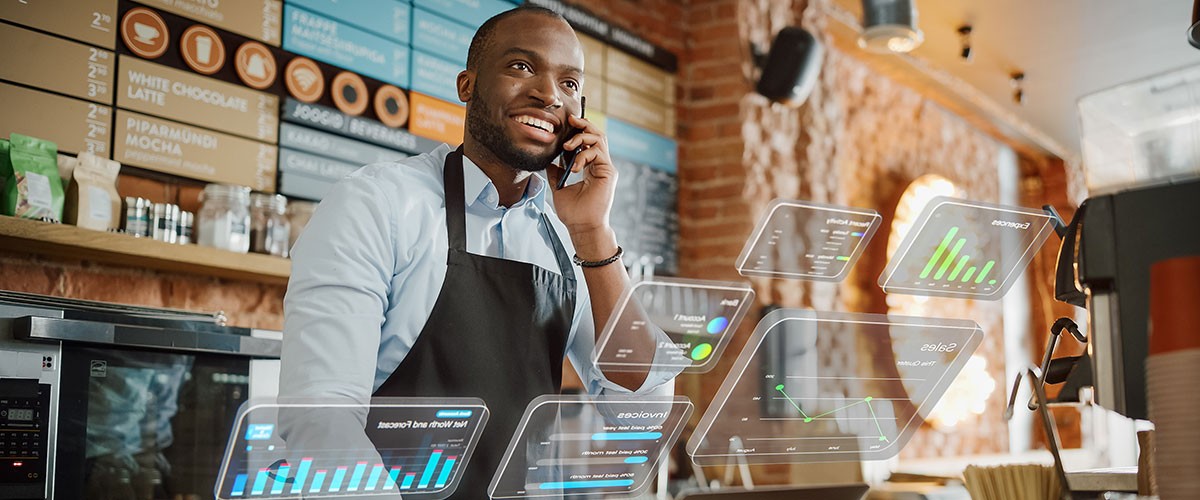
2. Real-Time Order Tracking Dashboards
AI-powered dashboards provide:
Live order status across systems
Exception alerts for delays or shortages
Visibility for sales, operations, and logistics teams
This shared view improves coordination and response time.
3. AI-Powered Voice Recognition for Orders
For distributors and manufacturers still receiving phone orders, AI voice recognition:
Converts spoken orders into digital records
Eliminates transcription errors
Accelerates order capture during the peak periods
4. Predictive Analytics for Better Order Forecasting
Predictive analytics is one of the most powerful applications of Industry AI.
AI forecasting models analyze:
Historical sales data
Seasonal trends
Promotional activity
Customer ordering patterns
The result is more accurate demand forecasts that improve order quality and inventory alignment. Food businesses can reduce stockouts, minimize overproduction, and better plan labor and transportation.
5. Real-Time Integration with Fulfillment and Delivery
AI does not operate in isolation. It integrates with warehouse, transportation, and distribution systems to optimize fulfillment.
Key benefits include:
Dynamic order routing based on inventory availability
Accurate ETA predictions
Optimized delivery sequencing for perishables
When AI connects order management with execution systems, companies gain end-to-end operational visibility.
What Are the Key Ways AI Improves Order Management?
AI delivers measurable improvements across the order lifecycle:
Faster order processing with reduced backlogs
Greater forecast accuracy through demand prediction
Lower operational costs via automation
Higher order accuracy and fewer returns
Real-time visibility across supply chains
These gains compound over time as AI models learn from new data.
What Are the Benefits of AI Order Management for Food Businesses?
For food manufacturers and distributors, AI-driven order management delivers strategic value:
Improved order accuracy and fewer customer disputes
Faster fulfillment cycles and better on-time delivery
Lower operating costs through reduced manual labor
Reduced food waste through better demand alignment
Higher customer satisfaction and service levels
These benefits directly impact profitability and brand trust.
What Challenges Come with AI Order Management and How Can They Be Overcome?
AI adoption is not without challenges, but they are manageable.
Common obstacles include:
Data silos and inconsistent records
Resistance to change and skills gaps
Integration with legacy systems
Successful companies address these by:
Cleaning and standardizing data first
Starting with targeted AI use cases
Training teams alongside technology rollouts
How Does AI Order Management Integrate with ERP Systems?
AI works best when layered onto an existing ERP system.
Rather than replacing ERP, AI enhances it by:
Automating order workflows
Improving data accuracy across modules
Providing real-time insights across ordering, inventory, and logistics
ERP platforms designed for the food industry, such as those discussed on the VAI blog, provide the structured foundation AI needs to succeed.
When Is the Right Time to Adopt AI for Order Management?
Food businesses should consider AI when:
Manual order processing creates bottlenecks
Fulfillment delays become frequent
SKU counts and distribution networks grow
Forecasting errors impact inventory and waste
If order complexity is increasing faster than headcount, AI is no longer optional.
Conclusion
AI is rapidly becoming a competitive differentiator in the food industry. By optimizing order management with intelligent automation and predictive analytics, food businesses gain speed, accuracy, and resilience across their operations.
AI-driven order management reduces errors, improves forecasting, lowers costs, and supports scalable growth—without disrupting existing ERP investments.
Learn how AI order management can transform your food operations and position your business for long-term success.